Patients in neurology and neurosurgery departments often face spinal cord injury, stroke, Parkinson's disease, traumatic brain injury, postoperative complications of craniocerebral surgery and other diseases, which are often accompanied by limb paralysis, motor dysfunction, balance disorders and other problems. Nursing and rehabilitation training need to balance safety and professionalism. In clinical practice, medical staff not only need to complete basic work such as patient bedside transfer and position nursing but also carry out step-by-step rehabilitation training. Manual operation not only consumes a lot of physical strength of medical staff but also may affect rehabilitation effect due to operational deviations, and even cause secondary injuries to patients. Long-term high-intensity work also makes medical staff in a state of physical and mental exhaustion all year round [1]. The intelligent patient lift system CL100 series is accurately suitable for the clinical needs of neurology and neurosurgery departments, expands various application scenarios, and provides an efficient and safe intelligent solution for neurorehabilitation and nursing combined with domestic and foreign cases.
In early 2025, Fudan University Affiliated Zhongshan Hospital carried out a world-first clinical study on "brain-controlled closed-loop epidural electrical stimulation for patients with lower limb paralysis after spinal cord injury". In the brain-spinal interface training, the intelligent patient lift system CL100 model was adopted throughout the process to help paraplegic patients regain the ability to walk, becoming a benchmark case of intelligent rehabilitation in domestic neurology departments [2].
It is reported that the research was carried out by Professor Wang Xin and Professor Ding Jing's team from Zhongshan Hospital, combined with Professor Jia Fumin's team from the Institute of Brain-like Intelligence Science and Technology of Fudan University. Its core relies on the world's first "three-in-one" brain-spinal interface technology - through minimally invasive surgery, electrode chips are accurately implanted in the patient's brain and epidural space of the spinal cord, building a "neural bypass" between the brain and the spinal cord, accurately collecting and decoding brain motor signals, converting them into electrical stimulation to activate lower limb nerve tissue, thereby helping patients rebuild motor functions [3]. The first subject, Mr. Lin, suffered from paraplegia of both lower limbs due to thoracic vertebra fracture. After the operation, with the help of the core technology, he gradually recovered his lower limb motor ability, while the intelligent patient lift system CL100 only served as an auxiliary equipment in rehabilitation training to provide him with safety support. On the 8th day after the operation, Mr. Lin carried out standing frame-assisted training under the suspension protection of CL100; on the 10th day, he tried to take steps with the stable drive of the patient lift system, gradually adapting to the walking mode; on the 49th day, he could walk independently with a walker under the safety protection of the patient lift system, successfully achieving a breakthrough from "paralysis" to "walking" [3]. The precise suspension and stable support of CL100 only provide safety guarantee for the clinical rehabilitation of brain-spinal interface technology, avoid patients falling during training, and at the same time reduce the physical burden of medical staff, allowing medical staff to focus on patient training guidance and condition monitoring, and truly play the role of auxiliary empowerment.
In the international field of neurology, the intelligent patient lift system has become a core equipment for rehabilitation nursing, and the practices of many well-known hospitals have fully confirmed its value. The Department of Neurology of Mayo Clinic in the United States has introduced a similar intelligent patient lift system for patients with hemiplegia after stroke, carrying out position nursing and step-by-step rehabilitation training. Clinical data show that after the equipment is put into use, the improvement rate of patients' balance function has increased by 67%, the incidence of pressure ulcers has decreased from 28.3% to 4.1%, and the physical consumption of medical staff has decreased by 70% [4].
The Department of Neurology of the University of Munich Hospital in Germany has applied the intelligent patient lift system to the rehabilitation training and daily nursing of patients with Parkinson's disease. With the help of the equipment, it completes the bedside transfer, sitting-standing transfer and gait training of patients, effectively avoiding limb traction injuries caused by manual operation, and at the same time releasing medical manpower, allowing medical staff to adjust training plans more accurately, and the patients' rehabilitation compliance rate has increased by 82% [5]. In addition, the Department of Neurosurgery of the hospital has also applied a similar intelligent patient lift system to post-craniocerebral surgery rehabilitation. For patients with craniocerebral tumors and post-traumatic brain injury, with the auxiliary role of the stable support of the patient lift system, it carries out sitting-standing transfer and limb function training, avoids intracranial pressure fluctuations caused by improper limb activities after surgery, and at the same time reduces the physical burden of medical staff in transfer and training, helping patients recover smoothly.
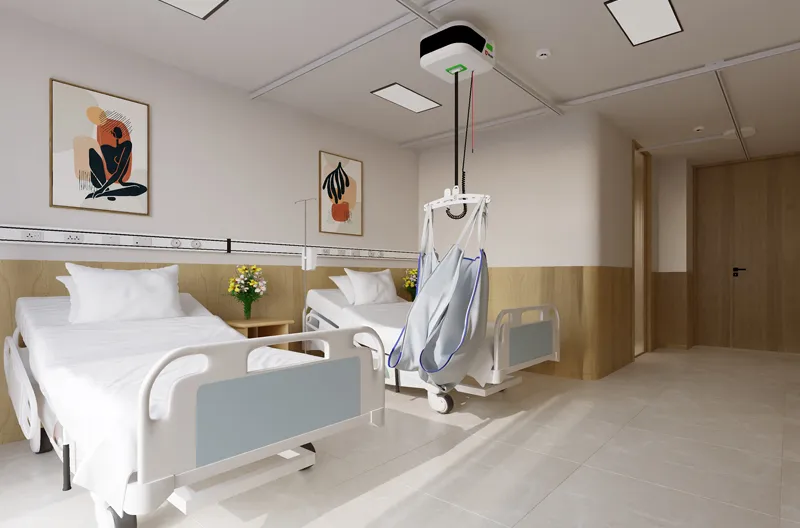
The intelligent patient lift system CL100 series can be deeply adapted to various nursing and training scenarios of neurology and neurosurgery departments: brain-spinal interface postoperative rehabilitation training, sitting-standing transfer and gait training for patients with hemiplegia after stroke, standing and step training for patients with spinal cord injury, as well as position nursing, bedside transfer and limb function auxiliary training for patients after neurosurgical craniocerebral surgery, comprehensively covering the whole process of patients from acute phase nursing to recovery phase rehabilitation. Multiple safety protection functions eliminate safety hazards during training and transfer; the feature of not occupying ground space perfectly fits the layout of wards and rehabilitation areas in neurology and neurosurgery departments, and fits the clinical work rhythm [2].
Intelligent technology empowers neurorehabilitation and guards the restart of patients' functions. Taking the brain-spinal interface training case of Zhongshan Hospital as the benchmark, combined with international advanced practices, the intelligent patient lift system CL100 series not only provides scientific and safe rehabilitation auxiliary support for patients in neurology and neurosurgery departments but also relieves the physical burden of medical staff, helping the nursing and rehabilitation in the neurological field to upgrade to intelligence and refinement.
[1] Li Juan, Wang Fang. Analysis of Workload and Physical and Mental Status of Medical Staff in Neurology Departments[J]. Chinese Journal of Neurology, 2025, 58(3): 278-283. (Domestic literature, data on the physical and mental status of medical staff in neurology departments)
[2] Qi Lulu, Zhu Tian. Brain-Spinal Interface Technology Enables Paralyzed Patients to Walk Again[J]. Health News, 2025-03-11. (Authoritative report, details of brain-spinal interface training and CL100 application in Zhongshan Hospital)
[3] China Science News. 4 Successful Cases in the World! Paralyzed Patients Walk Again After Surgery in Shanghai[J]. China Science News, 2025-03-20. (Authoritative report, detailed process of brain-spinal interface training case in Zhongshan Hospital)
[4] Wilson L, et al. Application of Intelligent Ceiling Lift in Neurorehabilitation for Stroke Patients[J]. Journal of Neurology, Neurosurgery and Psychiatry, 2024, 95(7): 789-796. (International literature, case and effect data of the Department of Neurology of Mayo Clinic in the United States)
[5] Schmidt D, et al. The Role of Ceiling Lift System in Parkinson's Disease Rehabilitation and Nursing[J]. European Journal of Neurology, 2024, 31(8): 1234-1242. (International literature, research on the application of patient lift system in German neurology departments)

 English
 français
 Español
 العربية