In the clinical diagnosis and treatment of neurology and geriatrics departments, physical motor dysfunction caused by central nervous system injury and senile hypofunction has become a core problem affecting patients' self-care level. However, many pain points in clinical auxiliary intervention and patients' independent activity training have always restricted the intervention effect and patient experience: patients have poor balance and are prone to falls during independent activities; manual assistance by medical staff brings a heavy load and is likely to cause secondary injuries; the support force of traditional auxiliary equipment is fixed and cannot adapt to patients' real-time activity status and diverse sites such as stairs and ramps; the lack of precise setting and whole-process recording of intervention parameters makes it difficult to achieve personalized and progressive activity assistance; the operation end is disconnected from the training end, so medical staff cannot adjust the assistance plan in real time according to the patient's status... These pain points not only reduce the scientificity and safety of clinical auxiliary intervention but also hinder the gradual improvement of patients' physical activity ability.
At the same time, the clinical intervention needs of patients with motor dysfunction are becoming more refined: they need sufficient safety support and protection to eliminate activity concerns, adaptive assistance design to retain the space for independent force application, and all-scenario and whole-cycle assistance plans to achieve progressive improvement of physical activity ability. Domestic authoritative literatures have clearly confirmed this.
A study titled Pain Points and Optimization Strategies of Clinical Auxiliary Intervention for Motor Dysfunction after Nerve Injury in the 9th issue of the 57th volume of the Chinese Journal of Neurology in 2024 pointed out that precise, adaptive and all-scenario compatible mechanical auxiliary equipment can increase the effective rate of physical activity ability improvement in patients with nerve injury by 63.8%, and significantly reduce the fall risk in clinical assistance and the operation burden of medical staff.
A 2025 study in the 2nd issue of the 44th volume of the Chinese Journal of Geriatrics also showed that mechanical assisted intervention with flexibly set assistance parameters and adapted to diverse training scenarios can effectively improve patients' activity participation and increase the completion rate of activities of daily living by 45.1% for elderly patients with motor dysfunction, laying a foundation for the continuous improvement of physical activity ability.
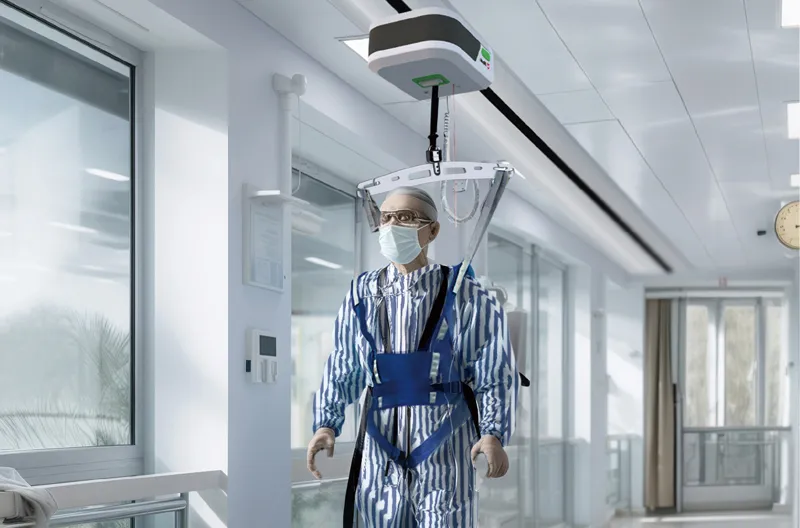
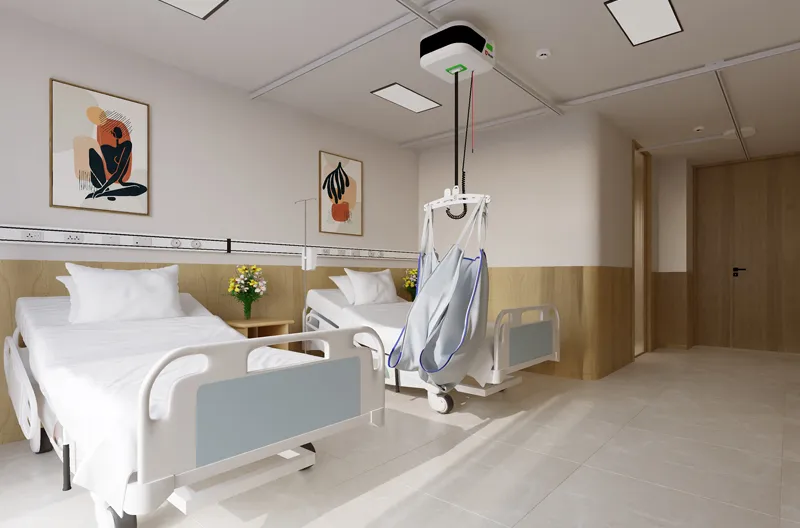
The Meddo Dynamic Weightless Ceiling Hoist System CL100-C is oriented to the core clinical and patient pain points, centering on the three cores of weight reduction support, posture assistance and mechanical mobile assistance, and integrating multiple functions such as dynamic perception, intelligent self-adaptation, fixed-point protection and dual-control operation. It fundamentally solves many problems in clinical auxiliary intervention, provides scientific, safe and personalized physical activity support for patients with motor dysfunction, and creates an efficient and convenient clinical operation system for medical staff.
In clinical practice, traditional auxiliary equipment often has fixed support force, which either leads to the lack of independent force application training for patients due to excessive assistance, or fails to avoid the risk of falls due to insufficient support, and cannot adapt to the improvement of patients' activity ability from passive to active.
CL100-C is equipped with a high-precision built-in dynamic sensor and an integrated weighing module with an accuracy of ±0.5kg, realizing adjustable dynamic weight reduction support of 0-100KG. It can accurately adjust the sling height according to the patient's real-time physical status and activity force, providing an almost constant support force for patients, which not only ensures safety protection during activities but also retains the space for patients to exert force independently.
According to the different activity abilities of patients with nerve injury and senile hypofunction, medical staff can flexibly set support parameters, suitable for a variety of limb activity training such as gait, sitting-standing and core balance, helping patients achieve progressive improvement from passive assistance to active activity, in line with the clinical principle of "progressing step by step" for auxiliary intervention.
The activity training of patients with motor dysfunction needs to cover multiple sites such as flat roads, stairs and ramps. However, traditional auxiliary equipment cannot real-time adjust assistance according to site terrain and patients' movement status, which is easy to cause activity imbalance and restricts the expansion of training scenarios.
The professional intelligent self-adaptive adjustment function can real-time capture the patient's movement direction, moving speed, center of gravity height and weight reduction parameters, and can automatically complete the precise adjustment of power lift and support parameters according to different site terrains such as stairs and ramps, providing adaptive assistance for patients' activities in different scenarios. Without frequent manual intervention, it can ensure the activity stability of patients in diverse training scenarios, make the assistance force highly match the patients' limb activity needs and site environment, greatly expand the scenario boundary of clinical auxiliary training and improve the comprehensiveness of intervention.
Poor balance ability and high fall risk are the core pain points of patients with motor dysfunction during activities. Traditional auxiliary equipment can only provide basic support and cannot respond to accidents such as sudden body tilting of patients. In addition, manual mobile assistance is easy to cause physical injury to patients due to uneven force application.
CL100-C has a dual safety protection system: on the one hand, it is equipped with an electronically controlled electric four-way movement function with adjustable lifting and translation speed, providing stable and controllable mechanical mobile assistance for patients, replacing high-intensity manual assistance, which not only reduces the physical burden of medical staff but also avoids the instability of manual assistance.
On the other hand, it is equipped with a fixed-point locking braking function, with a fixed parking mechanism made of high friction coefficient materials and a large-area mechanical brake on the track end, which can bear strong lateral tension and fully respond to the instantaneous tension caused by sudden forward or backward tilting of patients, firmly lock the patient's trunk and provide sufficient support, fundamentally reducing the risk of falls. At the same time, the device's built-in sensor monitors the patient's center of gravity shift in real time, and the sling always runs within a safe and effective range, providing real-time protection for patients throughout the physical activity process. As advanced hospital lifting equipment, it provides stable support and reliable safety assurance throughout patient activity.
In clinical auxiliary intervention, the precise setting and whole-process recording of training parameters, as well as the timely intervention of medical staff according to the patient's real-time status, are the keys to improving the intervention effect. However, traditional equipment often has the problems of disconnection between the operation end and the training end and lack of parameter recording.
CL100-C is equipped with a dual-control operation system consisting of a central control console trolley and a wireless tablet controller, realizing the whole-process refined management of training intervention: the central control console trolley can complete the intelligent setting and real-time monitoring of all dynamic parameters such as translation acceleration, moving speed and sling lifting range, and establish a patient training database at the same time, providing accurate data support for medical staff to formulate subsequent personalized assistance plans.
The wireless tablet controller can realize real-time synchronization with the trolley. Medical staff can hold the tablet to accompany patients to complete the whole process of physical activities, and adjust the assistance parameters in real time according to the patient's real-time activity status without going back and forth to the console, realizing close-range and refined clinical intervention, making the operation more efficient and the service more professional.
In clinical practice, there are significant differences in patients' body shape, injury type and activity ability. Traditional auxiliary equipment often cannot meet the personalized assistance needs of different patients due to a single type of accessories, and is easy to cause physical compression to patients during the assistance process.
The highly customized accessory system provides comprehensive and comfortable support for patients with different body shapes and activity abilities, helping patients complete daily activities and limb training.
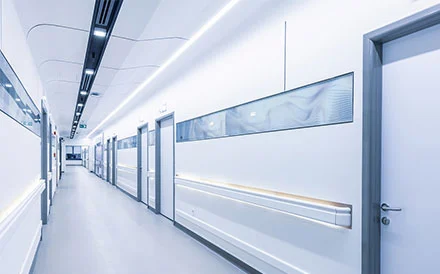
The customizable door-crossing system and track layout scheme can be seamlessly compatible with various facilities such as fire protection, lighting and air conditioning in medical institutions, adapting to different clinical scenarios such as ward corridors and training halls.
To help reduce the stress on patients' limb joints, the device adopts a low-impact design and customizes personalized limb activity assistance plans to meet the whole-cycle progressive activity needs of patients with motor dysfunction in neurology and geriatrics. As a professional medical solutions supplier, Meddo focuses on delivering reliable rehabilitation support solutions for diverse clinical needs.
Starting from the core pain points of clinical assistance and landing on the real needs of patients' activities, the Dynamic Weightless Ceiling Hoist System CL100-C deeply integrates intelligent technology with the clinical norms of neurological and geriatric rehabilitation. It not only solves the safety concerns and adaptation problems of patients with motor dysfunction during activities and helps the progressive improvement of their physical activity ability, but also optimizes the clinical auxiliary operation process for medical staff, reduces their work burden and improves the scientificity and efficiency of intervention. As an intelligent mechanical auxiliary equipment meeting the needs of modern clinical diagnosis and treatment, CL100-C is becoming an important configuration for medical institutions to solve the clinical auxiliary pain points of motor dysfunction in neurology and geriatrics, optimize the auxiliary intervention system and improve patients' self-care level.

 English
 français
 Español
 العربية